
How to analyze Facebook ad creatives and find ideas worth testing

Facebook ad creative research is not a contest to collect the most screenshots. The useful questions are how an ad attracts attention, what supports its product claim, and whether the landing page delivers what the ad promises. Teams advertising across markets also need to check the prices, offers, and delivery terms people see in each location.
The workflow below uses PrimeSpy to organize competitor creatives and form testable ideas. Dexodata then helps check the landing page experience in relevant markets. The intended output is an experiment your team can run, along with any page problems that need fixing.
Choose competitor ads that are worth comparing
Start with two competitors selling similar products to the same market. Keep five ads from each advertiser that use distinct messages or formats. Include newly observed creatives, variations on the same claim, and ads leading to different pages. A focused sample is easier to compare and review later.
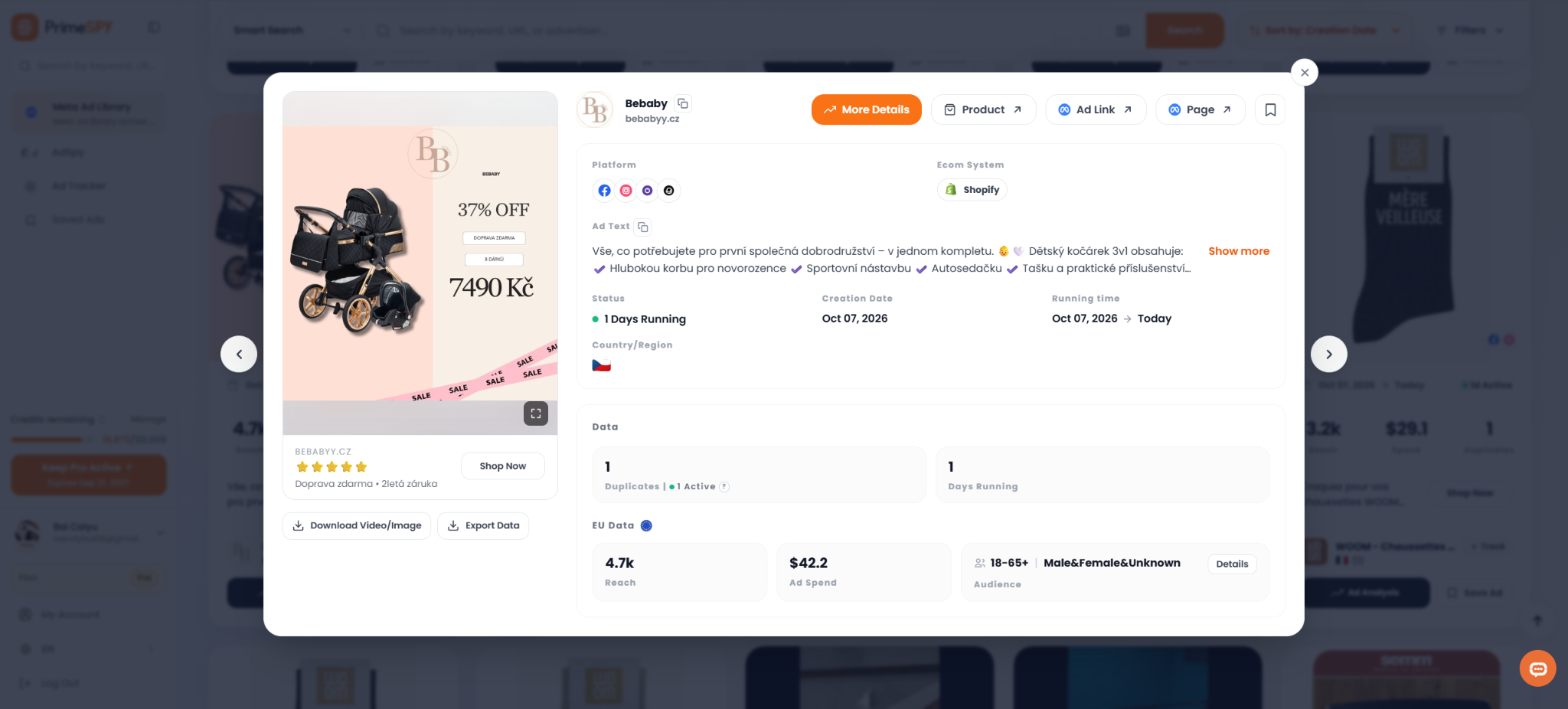
PrimeSpy supports ad search, filtering, and tracking. Its listed trial includes 500 credits and two ad trackers. Use the first two trackers for direct competitors, and record the advertiser, main claim, creative format, destination address, and observation date for each example.
An ad that keeps appearing is worth investigating. Its continued presence does not establish the advertiser’s budget, conversion rate, or profit. Public ad information provides research leads, not a performance report.
Examine the opening, evidence, offer, and destination
Opening. What appears in the first few seconds of a video: the product, a use case, a customer problem, or a price promise? For an image, can someone understand the product and offer at a glance? Write down the actual approach, such as “opens by showing cleanup,” instead of “strong hook.”
Evidence. Which product details, demonstrations, or customer comments support the message? Separate what the creative visibly shows from claims it does not substantiate. The aim is to identify an appropriate form of proof for your own product, not to reproduce someone else’s footage.
Offer. What conditions apply to a discount, gift, or shipping promise? “Up to 20% off” differs from “20% off everything.” An ad has limited space, but the destination should make purchase conditions easy to find.
Destination. Save the landing page and observation date. Does the first screen show the same product, main benefit, and clear next step? An ad can earn a click while the page fails to answer the shopper’s next question.
Turn competitor creatives into testable variables
A subjective ranking of ads rarely tells a team what to do next. Compare the concerns different creatives address. Imagine two ads for a portable coffee maker. One opens with brewing; the other opens with cleanup. The first may address product quality, while the second may address convenience.
That comparison suggests an experiment: “With the same product, audience, and landing page, does opening with cleanup generate more product page views than opening with brewing?” Changing one main variable at a time makes the result easier to interpret.
When competitors publish new creatives frequently, PrimeSpy’s Ad Tracker can help a team follow new ads, copy changes, and landing page updates. A repeated approach can become a test idea, but only your own campaign results can show whether it works for your business.
Check landing pages across markets with Dexodata
One Facebook ad can serve several markets, while its destination may show different currencies, prices, promotion rules, delivery areas, or languages. Opening the page once from your office does not confirm what shoppers in the target market will see.
Dexodata lists ad verification as a market research use case and offers residential and mobile proxy options. A relevant location on the Dexodata network can help a team check ads it is authorized to inspect and the public pages those ads lead to. The question is whether the regional page matches the promise, not how many sales a competitor made.
Define a precise question before checking. For example: “After clicking this ad, does a shopper in Germany see a euro price, local delivery terms, and the advertised discount?” Keep the device type, browser language, login state, and starting address constant while changing the access location. Record the final address after redirects, plus the product, price, offer, and call to action shown on the first screen.
Repeat unusual results under the same conditions. Cached content, a shopping cart, account region, or personalization may also change what appears. Save the visit times and screenshots so another team member can reproduce the finding.
Research on public competitor pages must follow the website’s rules and applicable law. Dexodata also describes web data collection as a use case, but access to login protected content, personal information, and pages that restrict automated collection requires separate permission checks.
What to fix when the ad and landing page disagree
Consider a hypothetical ad aimed at United Kingdom shoppers. It promises shipping included on orders over £40, while the local landing page says £50. This is an illustration, not a finding about a real brand. Save the exact wording, time, and access conditions. Check whether product restrictions or an expiry date explain the difference before changing the ad or page.
Prioritize problems that affect understanding or purchase: the wrong product, conflicting prices, inconsistent offer conditions, incorrect redirects, and an inability to complete checkout. If purchase is possible but the page language or first screen message does not align with the ad, make that a landing page test. Keep a competitor’s repeated creative format as a hypothesis until your own experiment evaluates it.
Dexodata also describes price comparison as a market research use case. A price check should capture more than a number. Record the currency, discount eligibility, shipping threshold, and observation date so the team can determine whether the ad and page actually conflict.
Before launching a creative experiment, check the destination again in each target market. If a local page shows the wrong offer, results after the click may reflect a page problem rather than the creative. Correct the experience first, then use product page views, additions to cart, or purchases to judge the ad.


